In an effort to keep tightening up my trades to cut short losses and lock in profits quickly, I've been playing around with some timed exit strategies for the past week or so (in case you were wondering why it's been so quiet around here).
In my regular daily trading I already have a very basic timed exit in place - after 24 hours in a trade, I'll either close it out or roll it over to the next day. But this is more a side-effect of the price data I used to design my trading system - I get the data in 24 hour units, so by default that's my minimum trading period.
However, I've been trying more aggressive trade-timing strategies via FX Engines, and so far have managed to crank up the backtested performance of my best GBP/USD engine by almost 1000 pips. I did this by using the time-out feature in their engine design tool, specifying that the engine automatically close out a trade after a certain number of days. The underlying idea is that a trade is likely to be profitable within a certain time window, and after that the chances of success drop off dramatically. This was already quite evident in the backtested results before I added a timed exit: successful trades averaged about 2.5 days in length, while unsuccessful ones tended to drag out for close to a week. So I figured, if the longest trades are most likely to fail, why not start cutting them short and see what happens?
After testing out that theory with a variety of timed exits, it turned out that there was indeed an optimal time period for my GBP/USD engine, after which the most profitable strategy was to just close out the trade.
This same principle might apply to your own trading. To find out, you could try timing every trade and then see how long a successful trade lasts, on average, versus how long an unsuccessful one takes. You could also monitor trades that closed quickly to see if they might have been profitable if they'd continued for a longer period.
Based on the data you gather, you may begin to notice patterns: perhaps you let your trades run on too long, hoping they'll turn around, when you should really be closing them quickly according to a strict timetable. Or on the other hand, maybe you're closing a lot of trades too soon because of tight stop-losses, or impatiently taking small profits instead of waiting for big ones. Whatever the answer, you'll be on your way to discovering the most profitable timeframe for your style of trading. Hope you find it!
Monday, February 5, 2007
Timed Exits


Whipsaws and Fake-outs
Some of the most frustrating and costly market phenomena a trader is likely to see are whipsaws and fake-outs. Actually these are pretty much the same thing, with the difference that calling it a fake-out attributes a negative intention to the market, essentially accusing it of messing with your head. And a whipsaw or fake-out can indeed have a serious impact on your confidence in yourself and your trading system. If you spend your days looking for price break-outs and trends and instead you get a string of these nasty up-and-down spikes, you may wonder why you got into trading in the first place. The past couple weeks have been a vivid case-study in whipsaws and fake-outs, which is why they seemed like a good topic for today.
So what is a whipsaw/fake-out, exactly? It's a point in the market where the price moves dramatically up or down, and in the early stages may look identical to the start of a new trend. Then, instead of continuing the trend or leveling off, it'll suddenly dive back down (or up, in the case of a downward spike) to a price close to where it started. If you've watched forex charts for any length of time, they've almost certainly crossed your path. But if you're new to the currency markets, or aren't sure exactly how to spot one, here are a couple from the past week's EUR/USD market.
 What causes them? Well, almost by definition they are points when there is insufficient momentum in a particular direction to sustain a trend. Because market sentiment is ambivalent, divided fairly evenly between longs and shorts, the price is able to continue its break-out and falls back to where it started. If you've placed your limit/take-profit orders at an optimistic price point in anticipation of a strong trend, you're likely to find the whipsaw comes nowhere near them and lands you back within a few pips of your entry price, and a few pips poorer thanks to spread costs.
The most dangerous whipsaws include price spikes in both directions, which after convincing you to place a trade in the direction of the first spike, then turn around and take out your stop-losses with the second spike.
If we broaden the definition a little bit, stop-hunting could be considered a type of whipsaw that's staged by a broker within their own trading platform with the specific goal of hitting their clients' stop-loss orders. If you see a whipsaw on your broker's charts but not on anyone else's, chances are you got stop-hunted.
That's not to say you can't make money on a garden-variety whipsaw or fake-out; I have no idea if it's possible during stop-hunting. If you're good at identifying markets in which they're likely to emerge (like the current one), you can adjust your trading strategy accordingly by placing your limit orders at levels closer to the entry price than you would in a trending market. You might also try combining these more modest limit orders with a tight trailing stop to help prevent all your profits evaporating when the price suddenly changes direction.
Or, if you're like me and find whipsaws and fake-outs too nervewracking, unpredictable, and costly to play with, you can work on filtering them out of your trading by avoiding market conditions when they occur. In my experience these tend to be in range-bound markets with low volatility and little notable economic news to fuel a true break-out. I'm sure someone out there is getting rich off these things, but it's definitely not me!
Fed News: Bernanke Bothered by Budget - Especially Medicare & Social Security
Last week Fed chairman Ben Bernanke testified to Congress about the state of the US economy, and chose to focus on the potentially dramatic disruptions to America's finances that could result from the gigantic impending deficits in the Medicare and Social Security budgets. Here are the highlights (or lowlights, if you prefer) from his testimony:
"Official projections suggest that the unified budget deficit may stabilize or moderate further over the next few years. Unfortunately, we are experiencing what seems likely to be the calm before the storm. In particular, spending on entitlement programs will begin to climb quickly during the next decade."
"...the outcomes that appear most likely, in the absence of policy changes, involve rising budget deficits and increases in the amount of federal debt outstanding to unprecedented levels."
"Under these assumptions, the CBO [Congressional Budget Office] calculates that, by 2030, the federal budget deficit will approach 9 percent of GDP--more than four times greater as a share of GDP than the deficit in fiscal year 2006."
"A particularly worrisome aspect of this projection and similar ones is the implied evolution of the national debt and the associated interest payments to government bondholders. Minor details aside, the federal debt held by the public increases each year by the amount of that year's unified deficit. Consequently, scenarios that project large deficits also project rapid growth in the outstanding government debt. The higher levels of debt in turn imply increased expenditures on interest payments to bondholders, which exacerbate the deficit problem still further. Thus, a vicious cycle may develop in which large deficits lead to rapid growth in debt and interest payments, which in turn adds to subsequent deficits."
"To some extent, strong economic growth can help to mitigate budgetary pressures, and all else being equal, fiscal policies that are supportive of growth would be beneficial. Unfortunately, economic growth alone is unlikely to solve the nation's impending fiscal problems. Economic growth leads to higher wages and profits and thus increases tax receipts, but higher wages also imply increased Social Security benefits, as those benefits are tied to wages. Higher incomes also tend to increase the demand for medical services so that, indirectly, higher incomes may also increase federal health expenditures."
"To the extent that federal budgetary policies inhibit capital formation and increase our net liabilities to foreigners, future generations of Americans will bear a growing burden of the debt and experience slower growth in per-capita incomes than would otherwise have been the case."
"Crucially, whatever size of government is chosen, tax rates must ultimately be set at a level sufficient to achieve an appropriate balance of spending and revenues in the long run. Thus, members of the Congress who put special emphasis on keeping tax rates low must accept that low tax rates can be sustained only if outlays, including those on entitlements, are kept low as well. Likewise, members who favor a more expansive role of the government, including relatively more-generous benefits payments, must recognize the burden imposed by the additional taxes needed to pay for the higher spending, a burden that includes not only the resources transferred from the private sector but also any adverse economic incentives associated with higher tax rates."
"To summarize, because of demographic changes and rising medical costs, federal expenditures for entitlement programs are projected to rise sharply over the next few decades. Dealing with the resulting fiscal strains will pose difficult choices for the Congress, the Administration, and the American people. However, if early and meaningful action is not taken, the U.S. economy could be seriously weakened, with future generations bearing much of the cost. The decisions the Congress will face will not be easy or simple, but the benefits of placing the budget on a path that is both sustainable and meets the nation's long-run needs would be substantial."
Hmmm...do you see Congress and the Administration taking up this difficult task with discipline and expediency? If not, you're probably short the dollar right now.
The Kill Switch is Working
I haven't been doing a lot of trading the last week or so, which given current market conditions turned out to be a very good thing. I recently added a new set of filters to my trading signals and they create very strict conditions for when I can enter certain trades - and for the past couple weeks they've been switched on most of the time. I just went back and looked at how my system would've performed without this new "kill switch" in effect and it wasn't pretty: in total it's saved me from over 150 pips in losses in a little more than a week.
How does it work? Well, part of the equation is the Bollinger Band filtering I wrote about recently. The rest of the equation involves some internal feedback that would only really make sense to me if I described it so I'll spare you the details.
Another question well worth asking is why my system would have performed so badly in the current conditions. If you've been watching the EUR/USD for the past several days you'll see why immediately: lots of very range-bound activity, with false breakouts and whipsaws that all seem to settle back into the same general price zone day after day. This is the type of market that would absolutely destroy my trading account if I let it - but with the new trade filters in place, that's less likely to happen. (I hope.)
FX Engines Account Types
As I've mentioned before I'm an FX Engines user as well as an affiliate of theirs, and every so often I've written about a particular trading engine that works well for me, or a new trading feature they've rolled out. But in the past few weeks I've been getting feedback from readers of this blog about certain tools and features I recommend that don't seem to be available in their accounts.
For example, some account types don't allow you to create your own engines or trading signals, while mine does. On the other hand, while I can invent and test my own engines, I don't have access to their pre-built engines for trading the news. Since I wasn't sure exactly why this was, I checked in about it with FX Engines and got some helpful clarification from their representative Scott. Here's what he told me:
There are three account types available:
FX Trader: These are accounts designed to trade the news. This account has stock engines and signals, but no ability to create engines or signals.
FX Trader Plus: This is just like FX Trader but adds the ability to create exit signals and use them in trades.
FX Builder: This is the system building account option. You can create entry signals, exit signals, and engines. You can demo or live trade engines and back test them over 5 years of tic data. (This is the account I have.)
If you currently have an FX Trader account and want to try building your own engines, you can contact the support staff (like Scott) through the FX Engines interface and they'll be happy to switch it over for you. (And switch it back if you decide you liked your other account better.)
Scott also mentioned they'll be rolling out some new engine building features soon, which I'll be sure to post about when I have more details.
The Single Greatest Money Management and Risk Reduction Tool Ever Invented
It's taken hundreds of hours of careful analysis, hard-won insights and intense, often painful first-hand experience to discover the single most important key to successful risk management and capital preservation in a trader's career. And unlike so many tools available out there, this one doesn't involve complicated algorithms, clever hedging, or stop-losses that don't always stop your losses. In fact, this Holy Grail of risk management can be summed up in just two words:
Don't trade.
By which I don't mean never trade - I just mean don't trade unless you have absolute confidence in your trade and are willing to let it run its course to success or failure.
Here are some examples of times you might want to use this cutting-edge trading tool:
- You have no idea what the market is doing
- You have no idea what your trading system is doing
- You're faced with conflicting trading signals
- You're faced with zero trading signals
- You disagree with your trading signals
- You're panicking in the midst of a nasty drawdown and liable to do something desperate
- You've just opened a trading account, added a couple moving averages to your charts (using the default settings, of course) and are planning to make as many trades as possible today, sleep or no sleep
- The phrase "I'll trade my way out of this" keeps crossing your mind
Best of all, for a short time only, I'm offering this remarkable trading tool* to you free of charge. Now the only question is, do you have the courage not to trade?
*May not in fact be the greatest risk management tool ever invented, as if anyone could even know that in the first place. But it's a damn good one.
The Trillion Dollar Bet - Lessons from Long Term Capital Management
A while back the PBS series "Nova" did an excellent show called "The Trillion Dollar Bet" on the rise and fall of Long-Term Capital Management (LTCM), a hedge fund founded by Nobel Laureates Myron Scholes and Robert Merton. LTCM placed massive leveraged trades in derivatives (hence the show's title) and then collapsed in truly spectacular fashion in 1998 following economic turmoil in Asia and Russia, and for a brief period threatened to take much of Wall Street with it. You can read the entire transcript online, and it's well worth a look - a fascinating window into how things can go wrong for even the most rigorously calculated and tested financial models.
At the heart of LTCM's implosion, like that of Amaranth Capital, were common problems that every trader should be aware of: the potential for unexpected drawdowns in turbulent market conditions; the fallibility of trading rules and signals that depend on past market behavior and unquestioned assumptions about future behavior; and taking on too much risk through extreme leveraging.
A number of scholars, experienced traders and fund managers appear in the show, and their observations are some of the most valuable insights I took away from it. Here are a few highlights:
Leo Melamed: "You can't ignore an error. Once you realize that you've made an error, the best thing is to get out of that error and start again fresh, and that's what a good trader does."
"That's an old market rule: the market will test you and do what you don't expect it to do."
Stan Jonas: "It was as though the world was behaving exactly the way it had been writ on the blackboard...And then slowly and totally unexpectedly, a change in the market dynamics began to become apparent."
"When do you admit that you're wrong, start all over again, or when do you hang on and assume that the markets will turn around in your way? That's the biggest decision we all have to make."
Roger Lowenstein: "Although their models told them that they shouldn't expect to lose more than 50 million or so on any given day, they began to lose 100 million and more, day after day after day till finally there was one day, four days after Russia defaulted, when they dropped half a billion dollars, 500 million in a single day."
Alan Greenspan: "How much dependence should be placed on financial modeling which for all its sophistication can get too far ahead of human judgment?"
Peter Fisher: "If a random bolt of lightning hits you when you're standing in the middle of the field, that feels like a random event. But if your business is to stand in random fields during lightning storms, then you should anticipate, perhaps a little more robustly, the risks you're taking on."
Bollinger Band Trade Filtering
In the spirit of my New Year's resolution to put my trading system on a diet, I've been exploring ways to more aggressively filter out unnecessary trades, boost my trading odds, lower spread costs, and generally fine-tune my system to optimize its performance.
One filtering method I've found that shows a lot of promise involves Bollinger Bands, but not in the way they're usually used. Until now I used Bollingers to identify points where the price was likely to begin a reversal from a (relatively) overbought or oversold position (in forex, all things are relative). But for my current trade filtering project, I'm using them to identify periods of low volatility, when the EUR/USD pair is trading within a narrower range.
The measurement I'm using to determine these periods is the distance between the upper and lower Bollinger Band. When the bands are further apart, the market tends to be in a more volatile, wider-ranging phase. My forex strategy works best in these types of periods (as do most trading systems, I suspect). When the bands are close together, volatility is lower and my system tends to accumulate losses and trading costs.
So what I've done is have my trades switched off when the Bollinger Bands are too close together; the optimal distance between them is something I've determined through a lot of backtesting. What I've found is that my trading odds and performance improve significantly, with fewer big drawdowns and pointless trades when the markets are in the doldrums. Of course, because Bollingers are a lagging indicator, I also miss some big breakouts when the market shifts back from low to high volatility. But I'm willing to live with that - consistent trading performance is far preferable in the long run, and there's nothing that can kills your morale more quickly than waiting out a series of bad trades when the market's drifting in no particular direction. The more of those ugly periods I can avoid, the better!
Interactive Brokers • The Choice of Professional Forex Traders
Interactive Brokers is the choice of professional forex traders because of our tight interbank spreads, advanced FXTrader order entry tool, and tight integration with other asset classes such as forex futures and options. In addition our IB Universal AccountTM allows customers to trade assets in multiple currencies and convert the proceeds at professional rates.
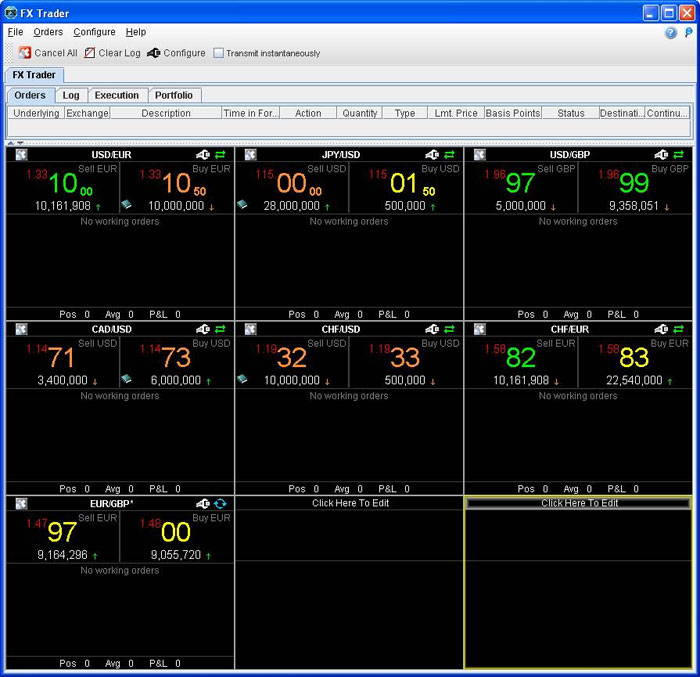
Interactive Brokers provides two vehicles for the exchange of currencies: IDEALPRO which allows a customer to trade Forex and IDEAL which allows a customer to convert their balances from one currency to another. Whatever currency balances you may hold, we always pay higher interest on credit balances, and charge lower interest rates on debit balances.
IDEALPRO provides professional Interbank spreads which are generally 0.5-3 PIPs (smallest price increment) wide, but the minimum order size is $25,000 or USD equivalent. Multiple large forex dealers provide direct price feeds with IDEALPRO displaying the composite of the best available price. With our universal account, it is easy to trade IDEALPRO cash along with currency futures from a single screen. To promote price transparency, as is the custom with all our products, we have separated our commissions from the quoted price. Please keep in mind that although many brokers don't explicitly charge forex commissions, they do build their commissions into the price spread.
IDEAL (for currency conversions) provides bid and ask quotes at spreads that are better than what you can obtain at your bank or through a credit card transaction. There is no minimum order size for an IDEAL order.
All forex trades are entered through the Trader Workstation like any other trade. The currency you wish to buy or sell is the transaction currency and is entered like any other securities or futures market data line into the Trader Workstation. You then choose Forex as the assets type and select a settlement or payment currency. Currency exchanges can be entered in one of two ways as buying one currency is the same as selling the other currency. Buying a transaction currency of Euros with a settlement currency of USD is the same as selling a transaction currency of USD with a settlement currency of Euros.
Example 1
If you want to buy/sell a specific amount of GBP, first enter the symbol GBP as the transaction currency. Then choose USD as the settlement currency from the drop down menu. You will then receive the quote USD/GBP, e.g. Bid: 1.5300 Ask: 1.5310 This means that GBP 1 = US$1.53XX
If you want to buy GBP 10,000, click on the ask and enter 10,000 as the quantity of GBP that you wish to buy. You will pay $1.5300 for each GBP. Thus, you will pay $15,310.
If you want to sell GBP 10,000, click on the bid and enter 10,000 as the quantity of GBP that you wish to sell. You will receive $1.5300 for each GBP. Thus, you will receive $15,300.
Example 2
If you want to buy/sell a specific amount of USD, first enter the symbol USD as the transaction currency. Then choose GBP as the settlement currency from the drop down menu. You will then receive the quote GBP/USD, e.g. Bid: 0.6530 Ask: 0.6536 This means that USD 1 = GBP 0.653XX
If you want to buy USD 10,000, click on the ask and enter 10,000 as the quantity of USD that you wish to buy. You will pay GBP0.6536 for each USD. Thus, you will pay GBP 6,536.
If you want to sell USD 10,000, click on the bid and enter 10,000 as the quantity of USD that you wish to sell. You will receive GBP0.6530 for each USD. Thus, you will receive GBP 6,530.What is Foreign Exchange?
The Foreign Exchange market, also referred to as the "Forex" market, is the largest financial market in the world, with a daily average turnover of approximately US$1.2 trillion. Foreign Exchange is the simultaneous buying of one currency and selling of another. The world's currencies are on a floating exchange rate and are always traded in pairs, for example Euro/Dollar or Dollar/Yen.
Where is the central location of the FX Market?
FX Trading is not centralized on an exchange, as with the stock and futures markets. The FX market is considered an Over the Counter (OTC) or 'Interbank' market, due to the fact that transactions are conducted between two counterparts over the telephone or via an electronic network.
Who are the participants in the FX Market?
The Forex market is called an 'Interbank' market due to the fact that historically it has been dominated by banks, including central banks, commercial banks, and investment banks. However, the percentage of other market participants is rapidly growing, and now includes large multinational corporations, global money managers, registered dealers, international money brokers, futures and options traders, and private speculators.
When is the FX market open for trading?
A true 24-hour market, Forex trading begins each day in Sydney, and moves around the globe as the business day begins in each financial center, first to Tokyo, then London, and New York. Unlike any other financial market, investors can respond to currency fluctuations caused by economic, social and political events at the time they occur - day or night.
What are the most commonly traded currencies in the FX markets?
The most often traded or 'liquid' currencies are those of countries with stable governments, respected central banks, and low inflation. Today, over 85% of all daily transactions involve trading of the major currencies, which include the US Dollar (USD) , Japanese Yen (JPY) , Euro (EUR) , British Pound (GBP), Swiss Franc (CHF) , Canadian Dollar (CAD) and the Australian Dollar (AUD).
Is Forex trading expensive?
No. FOREX.com requires a minimum deposit of $250. FOREX.com allows customers to execute margin trades at up to 200:1 leverage. This means that investors can execute trades of $10,000 with an initial margin requirement of $50. However, it is important to remember that while this type of leverage allows investors to maximize their profit potential, the potential for loss is equally great. A more pragmatic margin trade for someone new to the FX markets would be 20:1 but ultimately depends on the investor's appetite for risk.
What is Margin?
Margin is essentially collateral for a position. It allows traders to take on leveraged positions with a fraction of the equity necessary to fund the trade. In the equity markets, the usual margin allowed is 50% which means an investor has double the buying power. In the forex market leverage ranges from 1% to 2%, giving investors the high leverage needed to trade actively.
What does it mean have a 'long' or 'short' position?
In trading parlance, a long position is one in which a trader buys a currency at one price and aims to sell it later at a higher price. In this scenario, the investor benefits from a rising market. A short position is one in which the trader sells a currency in anticipation that it will depreciate. In this scenario, the investor benefits from a declining market. However, it is important to remember that every FX position requires an investor to go long in one currency and short the other.
What about terms like "bid/ask", "spread", and "rollover"?
FOREX.com has an extensive Glossary that provides detailed definitions of all Forex related terms
What is the difference between an "intraday" and "overnight position"?
Intraday positions are all positions opened anytime during the 24 hour period AFTER the close of FOREX.com's normal trading hours at 4:30pm ET. Overnight positions are positions that are still on at the end of normal trading hours (4:30pm ET), which are automatically rolled by FOREX.com at competitive rates (based on the currencies interest rate differentials) to the next day's price.
How are currency prices determined?
Currency prices are affected by a variety of economic and political conditions, most importantly interest rates, inflation and political stability. Moreover, governments sometimes participate in the Forex market to influence the value of their currencies, either by flooding the market with their domestic currency in an attempt to lower the price, or conversely buying in order to raise the price. This is known as Central Bank intervention. Any of these factors, as well as large market orders, can cause high volatility in currency prices. However, the size and volume of the Forex market makes it impossible for any one entity to "drive" the market for any length of time.
How do I manage risk?
The most common risk management tools in FX trading are the limit order and the stop loss order. A limit order places restriction on the maximum price to be paid or the minimum price to be received. A stop loss order ensures a particular position is automatically liquidated at a predetermined price in order to limit potential losses should the market move against an investor's position. The liquidity of the Forex market ensures that limit order and stop loss orders can be easily executed.
What kind of trading strategy should I use?
Currency traders make decisions using both technical factors and economic fundamentals. Technical traders use charts, trend lines, support and resistance levels, and numerous patterns and mathematical analyses to identify trading opportunities, whereas fundamentalists predict price movements by interpreting a wide variety of economic information, including news, government-issued indicators and reports, and even rumor. The most dramatic price movements however, occur when unexpected events happen. The event can range from a Central Bank raising domestic interest rates to the outcome of a political election or even an act of war. Nonetheless, more often it is the expectation of an event that drives the market rather than the event itself.
How often are trades made?
Market conditions dictate trading activity on any given day. As a reference, the average small to medium trader might trade as often as 10 times a day. Most importantly, by not charging commission, FOREX.com customers can take positions as often as necessary without worrying about excessive transaction costs.
How long are positions maintained?
Approximately 80% of all forex trades last seven days or less, while more than 40% last fewer than two days. As a general rule, a position is kept open until one of the following occurs: 1) realization of sufficient profits from a position; 2) the specified stop-loss is triggered; 3) another position that has a better potential appears and you need these funds.